Exploration de l'Algérois Culturel et Antique
Sur les terrasses blanches d'El Bahja, entre ruelles ottomanes et vestiges romains, l'âme méditerranéenne d'Alger se révèle.
Durée
8 jours
Saisons idéales
Mar, Avr, Mai, Oct, Nov
Style
Circuit accompagné
Confort
classique
Voyageurs
Couple, Solo, senior, groupe
L’esprit du voyage
Alger la blanche, appelée El Bahja – la joyeuse –, est considérée comme la première ville de la région du Maghreb. Fondée en 960 par Boulougine Ibn Ziri sur les ruines de l'ancienne cité romaine Icosium, l'ancienne cité ottomane s'étend sur une trentaine de kilomètres. Elle est bordée au nord et à l'est par la mer Méditerranée qui forme le célèbre golfe d'Alger, dominé par la Casbah, l'ancienne cité et Médina ; centre de rayonnement culturel et chef lieu de commandement militaire et politique. De nombreuses interventions étrangères (romaines, turques et françaises) ont touché la région d'Alger, la rendant une région internationale et ouverte sur le monde.
De la légendaire Casbah aux épiceries traditionnelles et jusqu’à sa cuisine, vous découvrez à chaque instant l’authenticité d’une ville qui tient à garder son âme … la ville de Muhammad Racim maître des arts plastique miniature, de Hadj M’Hammed El Anka le virtuose et doyen de la musique Châabi populaire, d’Albert Camus et de tant d’autres génies de la créativité où ils ont trouvé une source d’inspiration inépuisable.
Alger a su bénéficier de son riche patrimoine culturel méditerranéen et Africain car sa population très cosmopolite et métissée exprime une hospitalité spontanée et le sens d’un accueil sacré.
À quelques kilomètres, nous allons découvrir l'ancienne ville romaine de Tipaza, son musée antique et le Mausolée royal de Mauritanie.
Les étapes de votre voyage
Points forts
Itinéraire jour par jour

Vol international > Alger
Arrivée accueil et assistance à l'aéroport international d'Alger. Transfert par véhicule au centre ville. Installation dans une maison d'hôtes.

La Casbah d'Alger et notre Dame d'Afrique
Visite de la Casbah, la vieille Medina d'Alger. Surnommée Al Bahdja (La radieuse) ou (La blanche), tant par les Algériens que par les Français, elle est la capitale de l'Algérie et la plus grande ville du pays. Avec prés de cinq millions d'habitants, l'agglomération du grand Alger regroupe 10% de la population algérienne et se place à la première place des villes les plus peuplées du Maghreb.
La Casbah a été construite au 10e siècle. Nous entamerons notre visite par la Citadelle (le palais du Dey) ou Dar El Soltane. Les lieux à visiter : la mosquée du Dey, le club des Janissaires, les artisans (céramiste, ébéniste, etc.), les ruelles où a été tourné le film La Bataille d'Alger de Gillo Pontecorvo (sorti en 1966), la mosquée Sidi Mohammed Chérif, la fontaine de Sidi Mohammed Chérif, le musée Ali la Pointe, le marché de la mosquée des Juifs, la périphérie de la mosquée Ketchaoua et le musée Mustapha Bacha. La durée de la visite est de 3 à 4 heures maximum, cela dépend du rythme du groupe.
Déjeuner en repas traditionnel chez une table d'hôtes de la Casbah.
Poursuite de notre visite dans l'après midi à travers la place des martyrs. Visite du Palais des Raïs « Bastion 23 » - Centre culturel des arts – seul témoin de l'extension de la Casbah jusqu'à la mer. Ensuite, nous irons en hauteurs (transfert par véhicule) pour visiter « La Basilique de Notre Dame d'Afrique ». Si le ciel est beau nous pourrons probablement assister à un beau coucher du soleil.
Retour en centre-ville. Dîner libre. Nuitée à la maison d'hôte.

Le Bardo et Alger l'insolite
Visite du musée du Bardo dans la matinée. La villa, dont le commanditaire est un riche Tunisien exilé, Mustapha Ben Omar, a été construite sur les hauteurs d'Alger à fin la du 18e siècle afin de servir de résidence d'été pour l'accueil des notables de l'époque. Tour à tour, la propriété passe par plusieurs personnes, dont l'amiral Maurice Exelmans en 1830, le général Valentin Auguste Lichtlin en 1846, l'officier et artiste peintre paysagiste Prosper Baccuet en 1851, monsieur Grauby en 1868, puis Madame Aziza Fao, fille du marchand juif Joseph Cohen-Bacri en 1874. En 1875, la villa devient la propriété d'Ali Bey Bouakkaz, Agha de Biskra, puis il l'a revendit 1879 à monsieur Pierre Joret, dernier occupant de la villa.
A son décès, sa sœur, madame Frémont, céda la villa du Bardo à l'État français en 1926, qui la transforme en Musée d'Ethnographie et d'Art indigène. Inauguré en 1930, à l'occasion du centenaire de la colonisation, le musée devient Musée de Préhistoire et d'Ethnographie, dont le fondateur et le premier conservateur est le préhistorien Maurice Reygasse, puis Musée national du Bardo en 1985, et classé la même année monument historique.
Concernant le mot Bardo, il serait une déformation qui provient du nom espagnol Prado, ce qui signifie jardin, lieu de plaisir. Il renverrait aux somptueux palais des sultans Hafsides qui remonteraient au 15e siècle et dont on retrouve la trace en banlieue tunisienne. En ce moment, le musée du Bardo abrite une importante collection d'ethnographie et d'art Africain.
Visite du centre ville – l'Alger insolite –, rue Didouche Mourad, le marché, les boutiques d'artisanat jusqu'à la grande poste, ensuite la rue Larbi Ben M'Hidi - ex rue d'Isly - et la place Emir Abdelkader.
Promenade randonnée sur le front de mer.

Des beaux arts au jardin botanique du Hamma
Visite du musée national des Beaux-arts d'Alger, l'un des plus grands musées d'art d'Afrique. Ouvert au public depuis le 5 mai 1930, il est situé dans le quartier du Hamma, du côté du jardin d'essai du Hamma. Le musée avec ses 8 000 œuvres regroupe des œuvres peintes, des dessins, gravures et estampes anciennes, des sculptures, du mobilier ancien et d'art décoratif, de la céramique, de la verrerie, ainsi qu'une collection de numismatique. Parmi les œuvres exposées, figurent des peintures de maîtres hollandais et français comme Brugghen, Van Uyttenbroeck, Van Goyen, Monet, Matisse, Delacroix, Honoré Daumier, Renoir, Gauguin et Pissarro. Mais aussi les artistes algériens emblématiques, comme Baya, Yellès et Racim. Le musée abrite des sculptures de Rodin, de Bourdelle et de Belmondo.
Dans l'après midi, visite du Jardin botanique « Jardin d'essai du Hamma ». Créé en 1832, dans le but d'assainir un terrain marécageux en vue de le transformer en terre agricole, le Jardin devient une « Pépinière centrale du Gouvernement », qui s'étend d'abord sur 5 ha puis s'élargit à 18 ha en 1837. Par la suite, il devient « Jardin d'Acclimatation » puis « Jardin d'agrément » avec le développement de l'horticulture ; le but recherché étant d'introduire diverses espèces végétales afin de tester leur acclimatation et leur adaptabilité vis-à-vis du climat local.
Le Jardin d'essai d'El-Hamma a servi de décor naturel au tournage, en 1932, de Tarzan, l'homme singe du réalisateur américain Woodbridge Strong Van Dyke. Le personnage de ce seigneur de la jungle a été campé à l'écran, dans ce long métrage, par Johnny Weissmüller, acteur américain d'origine austro-hongroise. Tarzan, personnage de fiction connu à travers le monde, a inspiré plusieurs écrivains, réalisateurs et créateurs de bande dessinée. Il suffit de fermer les yeux pour imaginer, émanant d'un ficus géant, le tout premier cri de Tarzan

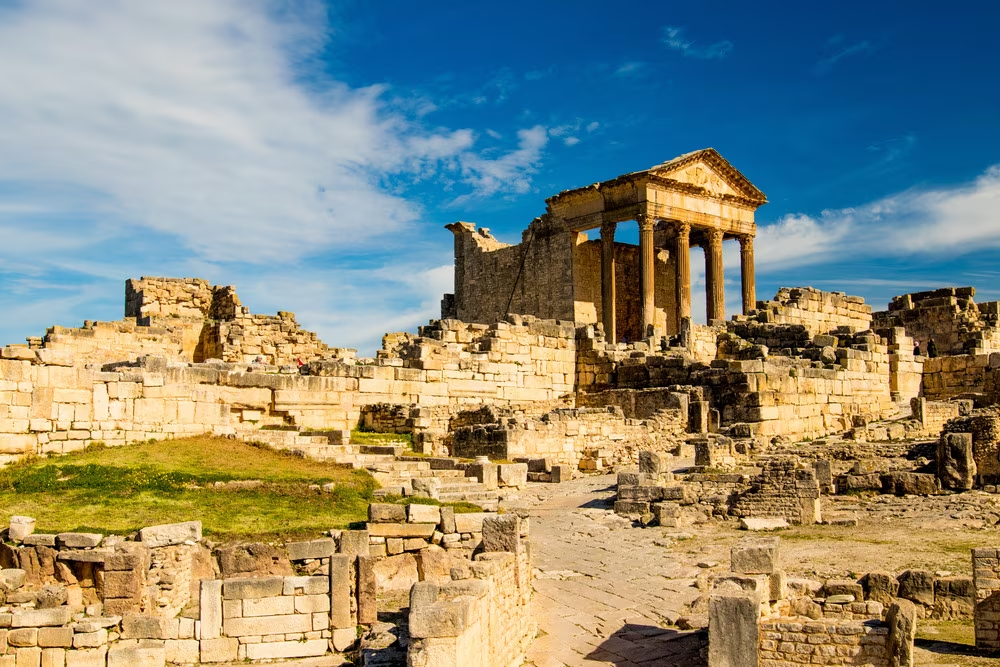
Tipaza l'antique à travers ses ruines Romaines du premier siècle
Départ tôt le matin pour la visite des ruines romaines du port de Tipaza. Située à 70 km à l'ouest d'Alger, la ville a été fondée par les Phéniciens vers le VIe siècle av. J.-C., et son nom signifie "lieu de passage". Cette ville enchanteresse a connu la succession de plusieurs civilisations :
La civilisation romaine : entre 145 et 150 apr. J.-C. (au IIe siècle de l'ère chrétienne), Tipasa devient une colonie romaine.
La civilisation vandale : son passage se situe vers le Ve siècle apr. J.-C.
La civilisation byzantine : au VIe siècle apr. J.-C., les Byzantins reprennent Tipasa.
La ville a été entourée d'une enceinte de 2200 mètres et 37 tours de garde. Le pourcentage des fouilles est entre 35 et 40%. Parmi les importants monuments que les visiteurs peuvent découvrir figurent : l'amphithéâtre, les temples, la villa (ou maison romaine), le théâtre, les thermes, la basilique, le forum, le tribunal, le nymphée (la fontaine publique) et la stèle commémorative d'Albert Camus. Je ne vous dirai pas plus, je vous invite à découvrir la beauté de cette ville riche en histoire et en mystères.
Visite dans l'après-midi du Mausolée royal de Maurétanie, fondé vers la fin du Ier siècle av. J.-C. C'est le tombeau de Cléopâtre Séléné, épouse de Juba II, qui était le roi de Césarée à l'époque (l'actuelle Cherchell, ville côtière située à 27 km à l'ouest de Tipaza). On présume qu'il s'agit du tombeau de Cléopâtre Séléné, fille de la célèbre reine Cléopâtre d'Égypte. Il est faussement appelé « Tombeau de la Chrétienne » en raison de ses quatre fausses portes ornées de moulures en forme de croix.

Le vieil Alger multiculturel et cultuel
Visite de la Grande Mosquée d’Alger dans la matinée. Par ses dimensions spectaculaires, la Grande Mosquée d'Alger est devenue la plus grande mosquée d'Afrique. Et c'est aussi la 3ième plus vaste au monde, derrière celles de La Mecque et de Médine en Arabie Saoudite. Étendu sur près de 30 hectares, son site dispose d'une vaste salle de prières, mais aussi d'un espace d'accueil pour des expositions, d'un musée d'art et d'histoire de l'islam à travers 15 siècles, d'une médiathèque, d'amphithéâtres et d'un centre de recherches. La capacité d'accueil totale du site près de 120.000 personnes. La gigantesque salle de prière peut elle recevoir quelque 35.000 fidèles.
Dans l’après midi, visite du Diocèse d’Alger. L'archidiocèse d'Alger est une église particulière de l'Église catholique en Algérie. Érigé en 1838, le diocèse d'Alger est élevé au rang de d'archidiocèse métropolitain en 1866. Son siège est la cathédrale du Sacré-Cœur d'Alger.
À la période romaine l’actuel site d’Alger était occupé par la ville d’Icosium (siège d’un évêché), qui dépendait de la province de Maurétanie césarienne, dont la capitale était Cherchell. Durant la période ottomane, des Pères lazaristes ont successivement occupé la charge de vicaire apostolique de 1650 à 1827, assurant alors le service des chrétiens, des bagnes, des commerçants et des consuls.
L’Eglise a retrouvé une structure diocésaine en 1838 par la création de l’évêché d’Alger, qui a couvert toute l’Algérie jusqu’en 1866, date où il est devenu archevêché avec la création des deux autres diocèses du Nord. Après Monseigneur Dupuch (1846-1866), qui fut l’interlocuteur de l’émir Abdelkader, et Monseigneur Pavy (1846-1866), le constructeur de la basilique Notre Dame d’Afrique, le Cardinal Lavigerie dirigea le diocèse d’Alger de 1866 à 1892. Il fonda dès son arrivée (1868) les Pères Blancs et les Sœurs Blanches (1869).
Dîner libre. Nuitée.

Découverte de Dar Essalam et du Palais des Raïs
Visite de la « Maison de la paix » Dar Esslam, basse Casbah d'Alger, qui a été inauguré le 22 juillet 2022 par le cheikh Khaled Bentounes, dédiée aux valeurs universelles de paix, de fraternité et d'humanité. Cet édifice portera le premier marqueur à Alger, faisant écho à la journée internationale du vivre ensemble qui a été décrétée par l'ONU le 8 décembre 2017 et la date retenue est le 16 mai. Initiative algérienne, initiée par le guide de la tariqa Alawiya le cheikh Khaled Bentounes.
Dans l'après midi, visite du Palais des Raïs – Centre des arts et culture-, appelé aussi « Bastion 23 », qui fait partie des plus importants monuments historiques de la ville d'Alger. Il représente, par ailleurs, l'un des derniers témoins qui attestent physiquement du prolongement de la Médina d'El Djazair (Casbah) vers la mer, à l'époque Ottomane jusqu'au XIXe siècle.
À la fin de la visite, nous allons prendre un café au « Café Malakoff », lieu mythique imprégné par le souvenir du maître de la musique Châabi El Hadj M'Hammed El Anka.
Dîner libre et soirée thématique de musique Châabi. Nuitée.

Alger > Départ sur un vol international
Petit déjeuner et départ vers l'aéroport, assistance au départ et embarquement sur un vol international.
Informations pratiques
L'inscription est considérée comme ferme et définitive après le versement d'un acompte de 30 % du prix total et l'acceptation des conditions particulières de vente.
Le solde doit être réglé au plus tard 45 jours avant la date de départ.
Consultez nos conditions particulières de vente pour le détail complet.
En cas d'annulation par le voyageur, les frais suivants sont retenus :
- Plus de 60 jours avant le départ : 40 % du prix total (acompte retenu)
- Entre 60 et 30 jours avant le départ : 50 % du prix total
- Moins de 30 jours avant le départ : 100 % du prix total
Nous recommandons vivement la souscription d'une assurance annulation. Consultez nos conditions particulières de vente pour le détail complet.
Les informations ci-dessous concernent les voyageurs ressortissants de l'Espace économique européen (EEE), de la Suisse et du Canada se rendant en Algérie dans le cadre d'un séjour touristique. Les règles d'entrée pouvant évoluer, nous vous recommandons de vérifier les informations auprès des autorités officielles avant votre départ.
Passeport
Pour entrer en Algérie, votre passeport doit être valide au minimum six mois après la date d'entrée dans le pays et comporter au moins une page vierge pour les tampons d'immigration.
Le document doit être en bon état (pas de pages détériorées, déchirées ou modifiées).
Visa
Les ressortissants de l'Espace économique européen, de la Suisse et du Canada doivent être en possession d'un visa valide pour entrer en Algérie dans le cadre d'un séjour touristique. Il n'existe pas d'exemption de visa pour ces nationalités.
Le visa doit être obtenu avant le départ, auprès de l'ambassade ou du consulat d'Algérie compétent selon votre pays de résidence. Il est conseillé d'en faire la demande plusieurs semaines à l'avance, les délais de traitement pouvant être variables.
Les documents généralement requis pour la demande de visa comprennent :
un passeport valide avec au moins six mois de validité résiduelle,
un formulaire de demande de visa dûment rempli et signé,
des photos d'identité récentes conformes aux normes requises,
un billet d'avion aller-retour ou une réservation,
une preuve d'hébergement (réservation d'hôtel ou invitation),
une preuve de ressources financières suffisantes pour la durée du séjour.
La durée de séjour autorisée est généralement de 30 jours, selon les conditions mentionnées sur le visa délivré.
Voyage avec des enfants
Les mineurs doivent être titulaires de leur propre passeport valide couvrant la durée du séjour.
Dans certains pays européens, lorsqu'un mineur voyage sans l'un de ses parents, une autorisation de sortie du territoire peut être exigée selon la réglementation du pays de résidence.
Santé
Aucune vaccination n'est officiellement exigée pour entrer en Algérie pour les ressortissants de l'EEE, de la Suisse et du Canada. Toutefois, il est recommandé de consulter un médecin ou un centre de vaccination avant le départ et de s'assurer que les vaccinations de base sont à jour (diphtérie, tétanos, poliomyélite, hépatite A).
Il est également conseillé de souscrire une assurance santé internationale couvrant les frais médicaux et le rapatriement pour toute la durée du séjour.
Autres nationalités
Les conditions d'entrée peuvent varier selon la nationalité. Les voyageurs concernés doivent se renseigner auprès de l'ambassade ou du consulat d'Algérie de leur pays de résidence.
Pour participer à nos voyages, il est fortement conseillé d'être assuré en assistance-rapatriement et frais médicaux à l’étranger.
Votre agence locale vous encourage à prendre connaissance du contrat spécifique élaboré avec notre partenaire CHAPKA ASSURANCES et AXA ASSISTANCE.
Pour souscrire à une assurance, connaître les garanties et les tarifs, suivez le lien ci-dessous.
CAP EXPLORER : La solution d’assurance complète conçue pour vivre sereinement votre voyage !
Choisissez la formule qui vous correspond le mieux:
Explorer'Multirisque
Explorer'Annulation
Explorer'Assistance
Explorer' Complémentaire Carte Bancaire
Spécifiques à nos voyages, nous suggérons fortement d’y souscrire.
Si vous choisissez de souscrire à l’une de ces formules, la convention détaillant l’ensemble des garanties et les modalités de déclaration du sinistre sont disponibles sur le site Internet de l'assureur.
Votre agence locale en aura connaissance, mais seul le participant est responsable du respect des procédures de déclaration de tout sinistre. Le participant doit donc conserver cette convention avec lui pendant toute la durée de son voyage.
Chapka — Cap Explorer
Notre partenaire assuranceVoyagez l’esprit tranquille avec notre partenaire Chapka. Annulation, rapatriement, frais médicaux, bagages… Toutes les garanties pour un voyage serein.
Partez en toute sérénité — je m’assureQuestions fréquentes
Parlons de votre aventure — Alger côte centre
Conseiller, basé·e à Ghardaïa / M'zab (puis Alger à partir de 2006)
L'Algérie ne se raconte pas en quelques pages. Elle se vit, du Nord algérois aux oasis du M'zab, dans la rencontre, l'accueil et le partage. Notre rôle est simplement de vous en ouvrir les portes, à votre rythme.
— Louiza